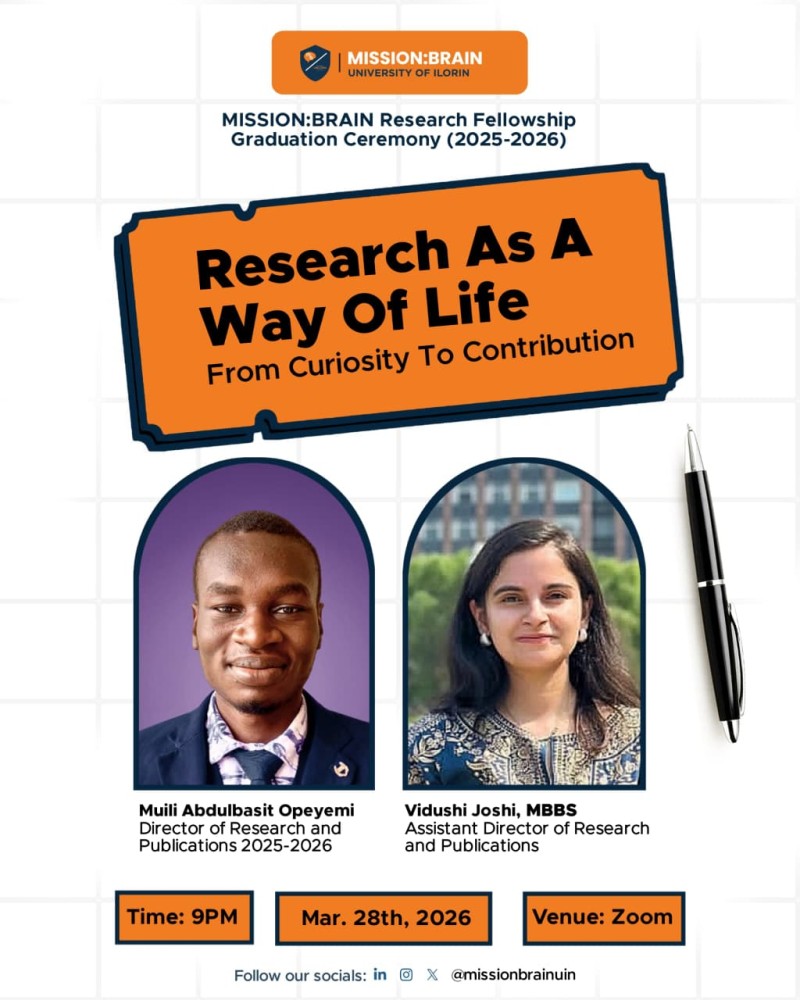
Research Fellowship Graduation Ceremony
From Curiosity to Contribution: Celebrating a New Generation of Student Researchers

🇻✨Dear readers,
Some events do more than close a chapter.
They reveal what the chapter has been building all along.
The Mission:BRAIN Research Fellowship Graduation Ceremony 2025–2026 was one of those moments — a celebration not only of completion, but of growth, discipline, community, and the quiet transformation that happens when young minds are taught to think like researchers.

Held under the theme “Research as a Way of Life: From Curiosity to Contribution,” the ceremony celebrated 32 graduating fellows from the first cohort of the fellowship programme at the University of Ilorin.
The ceremony was moderated by Dr. Vidushi Joshi, Assistant Research Director at Mission Unilorin, who guided the event with warmth, clarity, and a deep sense of purpose.

But this was not simply a certificate ceremony.
It was a reminder that research is not only something students do for a line on a CV.
At its best, research becomes a habit of mind.
A way of asking better questions.
A way of seeing problems more clearly.
A way of turning curiosity into work that can serve patients, communities, and the future of neuroscience and neurosurgery.
A Fellowship Built for the Next Generation
The ceremony opened with the presidential welcome address by Caleb Kolawole, President of Mission:BRAIN Unilorin.

His message brought the purpose of the fellowship into focus: to equip the next generation of student researchers in neuroscience and neurosurgery.
That vision matters deeply.
In a field where research can sometimes feel distant, intimidating, or reserved for only a few, the fellowship created a space where students could begin — not after becoming experts, but while learning how expertise is built.
Through mentorship, structured learning, collaboration, and exposure to research practice, the programme helped fellows move from simply being interested in research to beginning to understand what research demands: patience, clarity, discipline, teamwork, and intellectual honesty.
Looking Back on a Journey Across Borders
A major reflection came from Muili Abdul-Basit Opeyemi, the Director of Research and Publications.
His reflection placed the fellowship in a larger frame — not only as a training programme, but as a growing community of practice.

That phrase is important.
Because a true research culture is not built by one lecture, one manuscript, or one ceremony.
It is built when people keep learning together.
When students from different places exchange ideas.
When mentors make time.
When early researchers find the courage to ask questions.
When curiosity is not left alone but surrounded by guidance, structure, and community.
The fellowship journey showed that Mission:BRAIN Unilorin is not only producing fellows; it is helping build a network of young thinkers who see research as a shared responsibility.
Research Beyond the Project
The guest sessions gave the ceremony even deeper meaning.
Dr. Murshid Imam, a medical doctor, oncology researcher, and faculty member with academic and clinical training in China, brought the perspective of someone deeply engaged in both science and mentorship. His work focuses on cancer biology, hormone signaling, and novel therapeutic approaches, but his message to the fellows reached beyond any single research field.
Captions are auto generatedPlay

Speaking on integrating research into daily life, he reminded fellows that research is not limited to formal projects or publication deadlines.
It can become a mindset.
It can shape how a student reads, observes, questions, compares evidence, and responds to uncertainty.

His message emphasized the importance of intellectual adaptability — the ability to keep learning, keep adjusting, and keep thinking clearly in a world where knowledge continues to evolve.
Captions are auto generatedPlay

Atena Asghari, a fourth-year medical student at China Medical University, brought the voice of an emerging researcher still actively building her own academic path. With interests in epilepsy research, drug-resistant epilepsy, wearable biosensor clothing, medical education development, scientific writing, and academic publishing, she spoke with a perspective that many young researchers could relate to.

Her session on how to begin one’s journey as a researcher was especially important for students still standing at the starting line.
She reminded them that every research journey begins with initiative.
Not perfection.
Not complete confidence.
Not knowing everything.
But passion, curiosity, and the courage to take the first step.
The Fellows Speak

One of the most meaningful parts of the ceremony was hearing from the graduating fellows themselves.

Fellows including Godswill Uzoechina, Oluwapelumi Solagbade, Abdulrahmon Moradeyo, and others shared their personal experiences, learning outcomes, and reflections from the programme.

Their stories gave life to the fellowship.
They showed that the programme was not just about attending sessions or completing requirements.

It was about growth.
It was about learning how to think more critically.
It was about discovering the discipline behind research.
It was about understanding that contribution begins when curiosity is taken seriously.
Each voice carried a different journey, but together they reflected one message:
the fellowship had not only taught research skills — it had shaped research identity.
A Handover and a Promise of Continuity
The ceremony concluded with a significant leadership transition: the formal handover of the role of Director of Research and Publications from Muili Abdul-Basit Opeyemi to Godswill Uzoechina.
This moment was more than administrative.
It represented continuity.
It represented trust.

It represented the passing forward of responsibility.
In student-led movements, continuity is one of the hardest things to preserve. People graduate, roles change, teams evolve, and new leaders must carry forward what others began.
This handover showed that the research vision of Mission:BRAIN Unilorin is not ending with one cohort or one director.
It is moving forward.
It is being entrusted to new hands.
It is becoming part of the chapter’s living culture.
🇻✨ Vayda Reflects
🇻✨Dear readers,
The Mission:BRAIN Research Fellowship Graduation Ceremony 2025–2026 was not only about celebrating 32 fellows.
It was about witnessing what happens when curiosity is given structure.
When students are given mentorship.

When young researchers are given a community.
When questions are allowed to mature into contribution.
That is the beauty of this fellowship.
It reminds us that research is not just a destination for the already confident.
It is a path for the willing, the curious, the disciplined, and the teachable.
To the graduating fellows: Congratulations.

You are not leaving the fellowship with certificates alone.

You are leaving with sharper questions, stronger habits, deeper responsibility, and a clearer sense of what it means to contribute.
Keep reading.
Keep asking.
Keep building.
Keep serving through evidence.
Because research, when lived well, becomes more than academic work.
It becomes a way of life.
And from that way of life, contribution begins.
— Doc. Vayda
Link to our Graduation Ceremony ::


Leave a comment