When a government notification wasn’t enough
I never imagined that obtaining permanent registration in India would become one of the most challenging chapters of my medical journey.
After clearing the Foreign Medical Graduate Examination (FMGE), completing my internship, and fulfilling every requirement laid down by the National Medical Commission (NMC), I believed the most difficult part was behind me. Permanent registration felt like the final administrative step before beginning my career as a doctor.
I couldn’t have been more mistaken.
While every state in India has its own administrative process for granting permanent registration, what I experienced in Uttarakhand went far beyond routine paperwork. It became months of uncertainty, repeated visits to government offices, countless hours of waiting, and a constant struggle to have a government notification interpreted and implemented correctly.
For many Foreign Medical Graduates (FMGs), permanent registration marks the end of a long journey through medical school, internship, and licensing examinations. For us, however, it became the beginning of an entirely different battle.
This is not just the story of my registration.
It is the story of how my family, together with several other FMGs, fought—not for special treatment or exceptions—but for the fair and consistent implementation of regulations that already existed.
The Notification That Changed Everything
On 18 March 2026, the National Medical Commission (NMC) issued a public notice clarifying the eligibility of certain foreign medical graduates for permanent registration.
According to our understanding of the notification, students admitted before 18 Novemeber 2021 under the Foreign Medical Graduate Licentiate Regulations (FMGL), 2002, who had:
- passed the FMGE,
- completed a valid internship at their foreign medical institution, and
- fulfilled the COVID-19 compensation requirements,
were eligible to apply directly for permanent registration.
On paper, it seemed straightforward.
In reality, it became the beginning of a long battle.
Like many FMGs, I assumed I would simply submit my documents to the State Medical Council, complete the formalities, and receive my registration.
Instead, I found myself navigating a system where different interpretations of the same notification created uncertainty, delays, and frustration.
At that point, I had no idea that the next few months would involve repeated meetings with officials, discussions with other affected students, countless hours spent understanding regulations, and eventually presenting our case before the Honourable Health Minister of Uttarakhand.
Looking back now, I realize that this journey was never just about obtaining my own registration.
It became a fight for every FMG whose career had been delayed because a clearly written notification was not being applied consistently.
Our First Visit
Before visiting the State Medical Council in person, we had already submitted formal representations requesting permanent registration under the National Medical Commission’s public notice dated 18 March 2026. We believed that our documents clearly demonstrated our eligibility and hoped the matter could be resolved through the normal administrative process.
When we did not receive the clarity we were seeking, my father and I travelled to the State Medical Council office in April 2026, carrying neatly organised files containing every relevant document.
We weren’t asking for any exception.
We weren’t requesting a favour.
We simply wanted our application to be considered according to the NMC notification.
My father, Dr. Arvind Joshi, accompanied me throughout this process. Having spent decades in government service and handled numerous administrative and legal matters during his career, he approached the situation with remarkable patience and preparation.
When we met the registrar, we explained our case and submitted our documents.
His response, however, was brief.
“Arey babu, kar lena ek saal ki internship.”
I remember sitting quietly beside my father, resisting the urge to respond. Before entering the office, he had given me one instruction:
“Let me handle this.”
So I did exactly that.
Although we received an acknowledgement confirming that our documents had been submitted, it was clear that our journey was only beginning.
Seeking Help Beyond the Registrar
After leaving the registrar’s office, we knew that simply submitting documents would not be enough. Our application had been acknowledged, but there was no indication that the notification had been understood the way we interpreted it.
So we decided to seek help elsewhere.
Our next destination was the office of the Honourable Health Minister of Uttarakhand, Mr. Subodh Uniyal.
By some stroke of luck—and largely because of my father’s persistence—we were able to briefly meet him and explain our situation.
My father, Dr. Arvind Joshi, is a retired government officer who spent much of his career dealing with administrative and legal matters in the Cooperative Department. Over the years, he developed a thorough understanding of how government systems function and how to present a case logically and respectfully.
He also happened to know the Health Minister’s brother, an advocate at the Supreme Court, from their early years in government service. That acquaintance opened a door that many people never get the chance to knock on.
After patiently listening to us, the Health Minister called the registrar in our presence.
According to my father, he said:
“If their case is valid, give them permanent registration.”
The registrar’s immediate response was:
“But they studied some parts online.”
The conversation was brief, but it gave us something we had been missing—hope.
The Health Minister asked the registrar to hear our case properly the following day.
We left believing that perhaps the misunderstanding would finally be resolved.
We were wrong.
Meeting Others Fighting the Same Battle
The following day, we connected with another parent whose daughter had studied medicine in Xi’an, China.
Mr. Rastogi had already been helping several foreign medical graduates facing similar issues. His daughter, Sakshi Rastogi, was going through a registration struggle of her own.
That evening, my father shared everything that had happened with Mr. Rastogi.
He was surprised that the registrar had listened to us at all.
By then, many students had already experienced months—and in some cases years—of delays because of differing interpretations of the regulations.
Then we returned to our hometown, Haldwani, and visited the registrar’s office at Dehradun again in May 2026.
Unfortunately, nothing had changed.
The response remained the same.
It became clear that our problem was not a lack of documents. It was a difference in how the NMC notification was being interpreted.
At that point, my father and Mr. Rastogi decided that we should once again approach the Health Minister’s office, this time together.
Hours of Waiting
The next visit included not only my father and me, but also my brother, my uncle, and Mr. Rastogi.
One thing I learned very quickly during this journey is that meeting a minister requires patience.
A great deal of patience.
We reached around noon.
Hours passed.
People came and went.
Every few minutes someone would wonder whether our turn was finally approaching.
It wasn’t.
Only around five in the evening was my father finally called inside.
Five hours of waiting—for a conversation that lasted only a few minutes.
Yet those few minutes mattered.
My father later told us that he had once again explained our concerns, emphasizing that all we wanted was a proper hearing based on the NMC notification.
The Health Minister listened carefully and instructed that another meeting be arranged—this time involving the registrar, the affected students, and our parents—so that everyone’s grievances could be heard together.
It wasn’t a solution.
But it was progress.
For the first time, someone in authority had acknowledged that our concerns deserved a proper discussion.
We returned to the hotel that evening emotionally exhausted but cautiously optimistic.
The next day happened to be Sunday, giving us an unexpected opportunity to pause.
We didn’t know it then, but that break would become one of the most important turning points in our entire journey.
Learning to Fight My Own Battle
Monday brought an unexpected twist.
We had gone to meet the registrar once again, hoping the discussion arranged by the Health Minister would move things forward. Instead, we learned that he was unavailable.
At first, it felt like yet another wasted day.
Looking back, it was probably the most important day of this entire journey.
That afternoon, my father looked at me and said something I wasn’t expecting.
“Tomorrow, you’re going to speak.”
I looked at him, confused.
“I won’t say a single word,” he continued. “You will present our case.”
Until then, I had stayed mostly silent during meetings. I listened, observed, and let my father handle the discussions. He understood government procedures far better than I did, and I trusted his experience completely.
But now he wanted me to stand before senior officials and explain why we believed the NMC notification supported our case.
I didn’t panic.
If anything, I became determined to understand every aspect of our case thoroughly.
My father had only one instruction:
“If you’re asking for justice, you must understand your own case better than anyone else.”
That evening, our hotel room turned into a classroom.
We weren’t preparing a speech.
We were preparing a case.
Every question that could possibly be asked had to be answered with evidence, not assumptions.
Preparing Like It Was an Examination
We began with the NMC public notice dated 18 March 2026.
Instead of reading it casually, we studied every sentence.
Every paragraph.
Every word.
We weren’t looking for arguments—we were looking for clarity.
Whenever a sentence seemed confusing, we stopped and discussed it until we were confident we understood exactly what it meant.
Once we had broken down the notification, I created a flowchart showing how the regulations applied to our situation.
Seeing everything visually made the process much easier to understand.
Next, we organised every document we possessed.
Our compensation certificate.
Our internship completion certificate.
Our FMGE qualification.
Our university records.
We wanted every piece of evidence to correspond with a specific requirement mentioned in the notification.
Then came an unexpected but incredibly useful tool.
ChatGPT.
We uploaded the notification and asked it detailed questions.
“If a student has completed a valid foreign internship and possesses a COVID compensation certificate, how should this notification apply?”
“Does this document satisfy the conditions mentioned here?”
“What possible objections could authorities raise?”
We weren’t using the responses as legal authority.
Instead, we used them to challenge our own understanding.
If an answer raised a question we hadn’t considered, we went back to the notification and read it again.
By the end of the evening, we knew the document almost by heart.
Building Our Case
Preparation didn’t stop with the regulations.
We created a complete timeline of my medical education—from admission to MBBS, the disruption caused by COVID-19, the period of online teaching, my return to China, the compensation classes conducted by the university, my internship, and finally clearing the FMGE.
Everything was arranged chronologically so that anyone reviewing my case could understand my journey within minutes.
We also drafted formal letters.
One was written from my perspective, explaining why I believed I fulfilled the eligibility criteria.
Another was prepared by my father, presenting the issue from an administrative and legal standpoint.
Finally, we prepared something I hadn’t expected.
A Standard Operating Procedure (SOP).
The purpose wasn’t to challenge the authorities.
It was to simplify the process.
We wanted to provide a structured framework that officials could use while evaluating similar cases, ensuring that students with comparable backgrounds were assessed consistently.
By late evening, our table was covered with papers, highlighted notifications, handwritten notes, timelines, printed responses, and neatly organised files.
For the first time since this journey had begun, I didn’t feel anxious.
I felt prepared.
Tomorrow, I wouldn’t be speaking based on emotion.
I would be speaking based on evidence.
And that made all the difference.
We Were Not Alone
On Tuesday morning, we arrived at the registrar’s office around 11 a.m., carrying our carefully prepared files and hoping that this meeting would finally bring some clarity.
As we waited outside, something unexpected happened.
One by one, other foreign medical graduates began arriving.
Until then, I had thought this was mainly my battle.
I soon realized it wasn’t.
The waiting area slowly filled with students and parents, each carrying thick folders of documents and, more importantly, months—sometimes years—of frustration.
The first people we met were Mr. Rastogi and his daughter, Sakshi, who had completed her MBBS in Xi’an, China. She was accompanied by her close friend, Akanksha, another graduate from China. Both were completing their internships at Haridwar Medical College.
Soon after, I met Dr. Shivani, another graduate from China, and Saksham, who had also studied there and was completing his internship at Subharti Medical College.
Two students from Ukraine had also come to discuss their own registration issues.
Then there was Mr. Amit, whose daughter had faced a completely different challenge.
She had successfully completed the counselling process for internship allocation in Uttarakhand, paid the required fee, and fulfilled every formality. Yet she was never allotted an internship seat.
As he described everything his daughter had gone through, the pain in his voice was impossible to ignore.
Every family sitting in that waiting room had a different story.
But every story ended at the same place.
Uncertainty.
Different Cases. The Same Struggle.
As we began talking to one another, I realised how differently similar cases were being handled.
Sakshi and Akanksha had almost completed their internships when they were suddenly informed that they would have to undergo an additional year of clerkship.
Saksham had experienced something similar. Even while completing his internship, he had been instructed to undertake another year of clerkship.
Dr. Shivani’s situation was even more complicated. She had already completed clerkship—a programme for which students often have to pay hospitals simply to continue clinical training. Despite this, she too had been asked to complete another year of internship.
Listening to everyone, I couldn’t help but wonder how students with comparable educational backgrounds could receive such different decisions.
There seemed to be no consistency.
The more people spoke, the clearer it became that this was not about one individual application.
It was about how the regulations were being interpreted.
Stories That Stayed With Me
One conversation, in particular, stayed with me.
Saksham and his parents had travelled from Jammu and Kashmir. They told us that they had encountered similar difficulties in their own state before coming to Uttarakhand.
Their experience reminded me that this wasn’t confined to one office or one state.
Many foreign medical graduates across India were struggling to navigate the same uncertainty.
As we continued talking, another reality became painfully obvious.
This process wasn’t just delaying paperwork.
It was delaying lives.
Most of us were already in our late twenties. Some students were approaching thirty.
Many wanted to prepare for postgraduate entrance examinations such as NEET-PG, INI-CET, or even UPSC.
Others hoped to begin working, support their families, or plan the next stage of their careers.
Every additional year of internship or clerkship meant another year of postponing those dreams.
For the first time, I stopped thinking only about my own registration.
I began thinking about everyone sitting in that room.
Each person had invested years studying medicine.
Each had crossed countries, navigated a pandemic, passed licensing examinations, and fulfilled countless requirements.
Yet here we all were, waiting outside one office, uncertain about what our future would look like.
Waiting for Our Turn
Hours passed as we waited to meet the registrar.
The atmosphere was strange.
There was anxiety, but there was also solidarity.
We compared documents.
Shared experiences.
Asked each other questions.
Offered reassurance whenever someone seemed discouraged.
Most of us had never met before that day.
Yet within a few hours, it felt as though we were part of the same team.
None of us knew exactly what would happen inside the registrar’s office.
But we all knew one thing.
Whatever happened next would affect far more people than just ourselves.
The Meeting That Changed Our Strategy
Eventually, my father and Mr. Rastogi were called into the registrar’s office.
The rest of us remained outside, waiting anxiously.
Those few minutes felt much longer than they probably were.
When they finally returned, we gathered around them, eager to hear what had happened.
The news wasn’t encouraging.
According to my father, the registrar maintained his earlier position. While he acknowledged Sakshi’s case, he was non-committal about the others. He explained that the council’s online portal was still under development and that decisions on similar cases would be considered later.
He also mentioned that a meeting of State Medical Councils had recently taken place and that future decisions would be guided by the outcome of those discussions.
For us, that response raised an important question.
The National Medical Commission had already issued a clarification on 18 March 2026.
If the clarification already existed, why were students with similar backgrounds still receiving different decisions?
Was the issue the notification itself—or the way it was being interpreted?
None of us had a clear answer.
Conversations Outside the Office
As we continued talking, several students shared experiences from their own interactions with the registrar.
Some described feeling dismissed when they tried to explain their interpretation of the NMC notification.
Others felt they had not been given enough opportunity to present their documents or explain their circumstances fully.
Listening to these accounts, I realised how emotionally draining the process had become for many families.
Months of uncertainty had gradually turned into frustration.
Not because people expected special treatment, but because they wanted consistency.
Students who had studied under similar circumstances hoped that the same regulations would be applied in the same way.
A Decision We Made Together
Standing outside the office, our discussion slowly shifted from disappointment to action.
It was clear that repeating the same conversation with the registrar was unlikely to change anything.
We needed someone else to hear our concerns.
My father tried calling Mr. Dharmendra Uniyal, the Health Minister’s Personal Assistant, but he was occupied at the time.
Rather than wait, we made a collective decision.
We would go directly to the Health Minister’s office.
Together.
Our group now included students, parents, and guardians who had travelled from different parts of Uttarakhand—and even from outside the state.
Some students who had come with unrelated registration concerns chose not to accompany us because their cases involved different issues.
We understood their decision.
Every FMG’s journey was unique.
But for those of us whose cases revolved around the 18 March NMC clarification, our objective was the same.
We wanted the notification to be understood and implemented as it had been written.
Nothing more.
Nothing less.
As we left the State Medical Council office that afternoon, I noticed something had changed.
When I had first arrived, I was focused entirely on my own registration.
Now I was walking alongside people whose futures had become intertwined with mine.
We were no longer a collection of individual applicants.
We had become a group with a shared purpose.
And together, we headed toward the Health Minister’s residence, hoping that someone would finally listen.
A Meeting That Gave Us Hope
After leaving the registrar’s office, our entire group headed towards the residence of the Honourable Health Minister.
By then, it was already around three in the afternoon.
I remember the timing clearly because it was Tuesday, and I was observing a fast that day.
Once again, we found ourselves waiting.
Government offices have a rhythm of their own. Time seems to move differently there. Minutes feel like hours, and every time someone walks through the corridor, you wonder if your turn has finally come.
Fortunately, the wait wasn’t as long as during our previous visit.
While we were waiting, we met one of the government Personal Assistants attached to the Health Minister’s office.
Unlike many officials we had encountered over the past few weeks, he listened patiently.
We explained everything—our educational background, the NMC notification, the repeated delays, and the confusion surrounding its implementation.
More importantly, we explained how these delays were affecting students’ lives.
This wasn’t simply about obtaining a registration certificate.
Many of us had already spent years studying medicine abroad.
Some were preparing for postgraduate entrance examinations such as NEET-PG and INI-CET.
Others wanted to begin practising medicine or support their families.
Every unnecessary delay pushed those goals further away.
The PA understood our concerns and assured us that he would inform the Health Minister about our case.
A short while later, something unexpected happened.
Our names were called.
“Just Keep Walking.”
My father stood up immediately.
Then he turned towards us and quietly said,
“Just keep walking. Don’t stop.”
We followed him.
There wasn’t time to think.
Within moments, we were being escorted inside the Minister’s residence.
As we walked through the entrance, I realised that very few people waiting outside actually got the opportunity to present their concerns personally.
We felt incredibly fortunate.
Inside the Minister’s Residence
The atmosphere inside was completely different from what I had imagined.
Everything felt calm.
The room was bright, spacious, and welcoming. The seating arrangement reminded me of the royal courts often portrayed in Indian mythological dramas. The Honourable Health Minister sat in the centre, while officials and visitors were seated around him in a circle, discussing various public matters.
Instead of the tense atmosphere we had grown accustomed to over the past few weeks, the environment felt surprisingly warm and informal.
Tea, soft drinks, sweets, and snacks had been arranged for everyone.
We were invited to sit down.
Although we had arrived carrying files full of documents and months of frustration, we were received with warmth and courtesy. It immediately put everyone at ease.
I happened to be seated beside a gentleman who was associated with the Indian Red Cross Society. Sakshi and Dr. Shivani sat nearby, while Saksham and Akanksha were seated across from us.
For a brief moment, I looked around the room.
Then I reminded myself why we were there.
This was probably the most important conversation of our entire journey.
Presenting Our Case
Before we began discussing our concerns, the atmosphere was surprisingly relaxed.
Rather than immediately turning to regulations and official documents, the Honourable Health Minister struck up a casual conversation.
Since most of us had studied medicine in China, he was curious about our experiences there.
Saksham, with his usual warmth, spoke about life in China, the universities we had attended, the culture, and the country’s natural beauty. For a few minutes, the discussion had nothing to do with regulations or registrations. It was simply a friendly conversation that helped everyone settle into the meeting.
Only then did the Health Minister ask us why we had come.
I began by introducing our group as Foreign Medical Graduates from different universities, most of us having completed our MBBS in China. I explained that we were there to seek clarity regarding the implementation of the National Medical Commission’s public notice dated 18 March 2026.
I outlined our understanding of the Foreign Medical Graduate Licentiate Regulations (FMGL), 2002. According to our interpretation of the notification, students admitted under the 2002 Regulations who had passed the FMGE, completed a valid internship at their foreign medical institution, and fulfilled the prescribed COVID-19 compensation requirements were eligible for permanent registration.
I made one point very clear.
“We are not asking for any special favour,” I said.
“We are simply requesting that the regulations applicable to our batch be implemented as they were intended.”
I then explained how the COVID-19 pandemic had affected our education. Like medical students across the world, we attended online classes when international travel became impossible. Once restrictions were lifted, we returned to our respective universities, completed the prescribed compensation training, obtained our compensation certificates, and successfully completed our internships abroad.
From our understanding, we had fulfilled every requirement mentioned in the notification.
Yet students with similar backgrounds were still being directed to undergo an additional year of internship or clerkship.
That was the concern we had come to raise.
As the discussion progressed, it became an open and interactive conversation rather than a formal presentation.
The Health Minister listened attentively and asked questions throughout the meeting.
Whenever the legal framework came up, Sakshi explained why we believed the FMGL, 2002 continued to govern students admitted before the newer regulations came into effect.
Akanksha and Dr. Shivani also contributed throughout the discussion, sharing their own experiences and adding important perspectives whenever different aspects of our cases were discussed. Their inputs reinforced the fact that although each of us had a unique journey, the underlying issue was the same.
It truly felt like a team effort. Each of us spoke when our individual experiences could add something meaningful to the discussion.
Then the Health Minister made an observation that caught all of us by surprise.
“A rule cannot operate retrospectively.”
For a brief moment, the room fell silent.
We understood the point he was making, but we also knew that the answer lay not in our interpretation, but in the wording of the notification itself.
During our preparation, I had highlighted a particular paragraph in the NMC notice.
I opened the document, turned to the relevant page, and showed it to him.
The paragraph stated that students governed under the FMGL, 2002, who had completed a valid internship at their foreign medical institution, possessed a valid compensation certificate, and fulfilled the prescribed requirements would not be required to undergo an additional Compulsory Rotating Medical Internship (CRMI) in India.
He read the paragraph carefully.
The atmosphere in the room changed.
After a few moments, he immediately instructed his Personal Assistant to call the registrar.
Once connected, he said,
“Kisi ko pareshaan nahi karna chahiye kyunki ismein saaf-saaf likha hua hai… ….”
(“No one should be troubled unnecessarily because everything is clearly written in the notification……”)
He then directed that a formal meeting be held with the registrar on 31 May 2026 so that our concerns could be heard in detail.
For the first time in months, we felt that someone had truly listened—not only to our words, but to the notification and the evidence we had spent weeks preparing.
As the meeting concluded, refreshments were offered once again.
Everyone encouraged me to have something, but I politely declined.
I was still observing my fast.
Sakshi and Saksham laughed and insisted that I should at least have a sweet. When I refused, they jokingly helped themselves to my share instead.
It was a small moment, but after weeks of uncertainty, it brought a smile to all of us.
When we stepped outside, there was a feeling we hadn’t experienced in a long time.
Hope.
Walking Out Together
When we stepped outside, our parents were waiting.
For the first time since this journey had begun, there was genuine hope.
We hadn’t received a final decision, but we had been heard.
The gentleman from the Indian Red Cross Society introduced himself, and as we spoke, he asked where each of us had come from.
“I am from Haldwani,” I replied.
“Sakshi and Akanksha are from Roorkee.”
“Dr. Shivani is from Dehradun.”
“Saksham has travelled all the way from Jammu and Kashmir.”
Hearing us introduce ourselves made me realise something.
Only that morning, most of us had been complete strangers.
We had studied at different universities, belonged to different cities, and followed different paths to become doctors.
Yet one notification had brought all of us together.
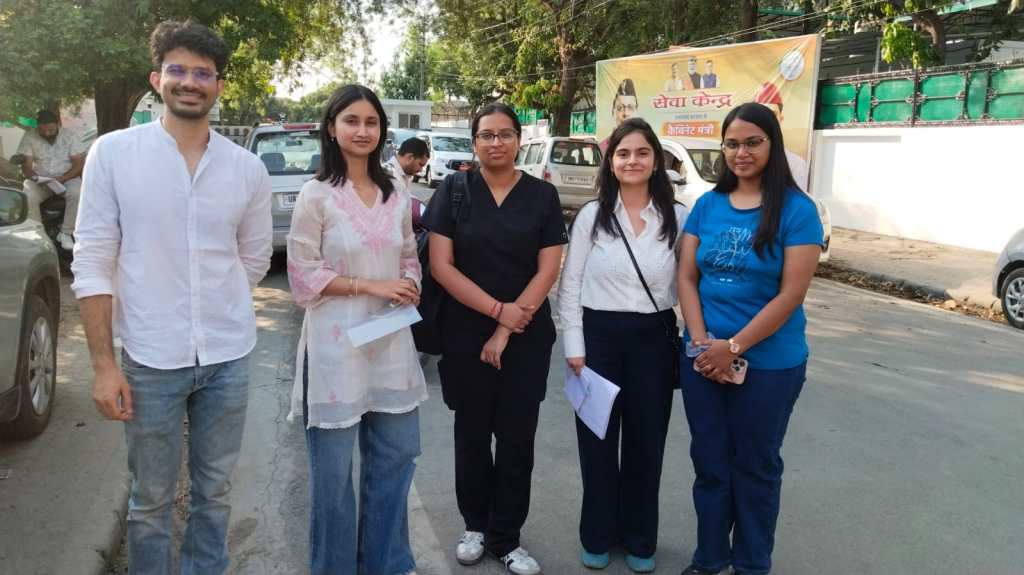
Our parents gathered around us, relieved and hopeful. My father, Dr. Arvind Joshi, insisted on taking photographs of all of us together to mark the day.
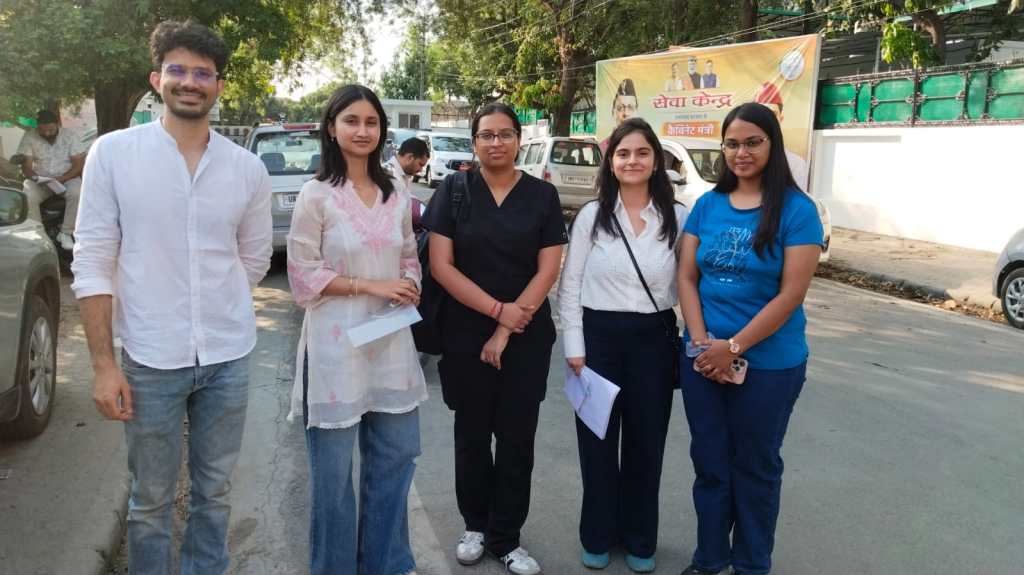
Looking back now, however, the photographs are not what I remember most.
What stays with me is something my father had told me much earlier, when I had suggested that perhaps I should simply complete another year of internship and move on.
He refused to let me think that way.
“This isn’t just your fight,” he told me. “If you’re going to fight, fight for everyone.”
At the time, I didn’t fully appreciate what he meant.
Today, I do.
Without his persistence, his preparation, and his determination, I don’t believe this journey would have unfolded the way it did.
That meeting gave us hope—but more importantly, it reminded me that meaningful change is rarely achieved alone.


Leave a Reply