May 28, 2025
What is OSCE ?
The OSCE exam (Objective Structured Clinical Examination) is a practical test used in medical training to assess how well future doctors, nurses, or other healthcare professionals can apply their skills in real-life situations. Think of it as a “hands-on skills check” instead of a written exam.
- “Circuit” of Short Stations:
- Candidates move through a series of “booths” (like stations at a science fair).
- Each station has a specific task (e.g., examining a patient, explaining a diagnosis, or practicing a procedure).
- Realistic Scenarios:
- Simulated Patients: Actors play the role of patients with specific symptoms or concerns.
- Mannequins/Tools: Used for physical exams (e.g., checking a knee injury) or procedures (e.g., bandaging a wound).
- Clinical Tasks: Reading an X-ray, washing hands properly, or counseling a patient.
- Timed & Structured:
- You have 5–15 minutes per station.
- A checklist marks whether you completed key steps correctly (e.g., “Asked about allergies” or “Listened to the patient’s lungs”).
- Tests Practical Skills:
- Communication: Can you explain things clearly and kindly?
- Clinical Skills: Can you spot signs of illness or perform exams safely?
- Professional Judgment: Do you make safe, ethical decisions?
Why It Matters:
- Safety First: Ensures medical professionals don’t just “know facts” but can actually do the job safely.
- Real-World Prep: Mimics the pressure and unpredictability of a real clinic or hospital.
- Fair Assessment: Every candidate faces the same scenarios, graded against the same checklist.
💡 Simple Analogy:
Imagine a driving test: You don’t just take a theory exam—you actually drive a car while an examiner watches your actions. The OSCE is like that, but for medical skills.
It’s a crucial step to ensure healthcare providers are competent, empathetic, and ready to care for real patients!
Marking scheme and content
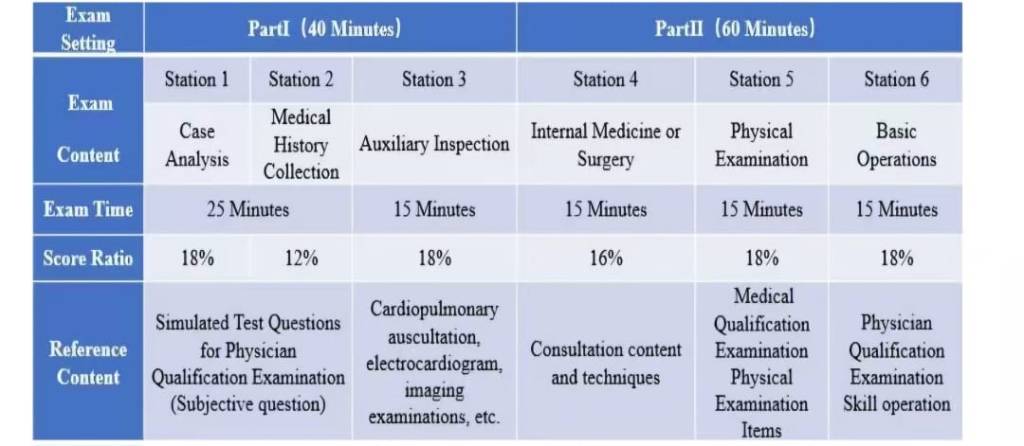
Study material
Physical Examination
- General Exam
- Head and Neck especially thyroid exam
- Cardiovascular
- Respiratory
- Abdominal
- Neurological (cranial nerves)
- Spine and Extremities
For physical examination, our university provided us with a set of videos that we could use for each system to revise what we had learned during clerkships. We watched them once or twice, but eventually ended up using Geeky Medics PE videos, a lifesaver, I might add.
Though I loved the Head and Neck PE on the university’s website, I would prefer it over others.
My bestie Jaseena and I practiced on each other (acting as patients) after watching every video, a great learning curve.
A quality of Jaseena is she makes delicious sambhar or food in general; the woman made me break a ten-year-long fast since middle school (eighth grade) of not having yogurt after preparing a delicious dessert of fruits and yogurt. Would recommend it to the readers considering I broke a ten-year-long fast for it (will tell the backstory behind that fast some other day; it’s one for the ages, though the story is over, I’m still writing pages, haha).
Operative techniques
- Lumbar puncture
- Thoracocentesis
- Abdominal paracentesis
- Aseptic principle (surgical draping and preparing the patient, scrubbing, wearing gloves , wearing surgical gown)
- Suturing (the TUGSS webinar really sharpened my skills for the exam)
- CPR
- Bone marrow aspiration and biopsy
Our university provides us with a book for basic operative techniques that explains each and every skill an intern should master. There are two versions—Chinese and English.
Two days before OSCE, my bestie Jaseena and I had a co-study session; I studied from the English version, and she translated (God bless Deepseek) and studied the Chinese version (which actually has the scoring criteria for the exam as well).
Subsequently, we practiced these skills (though we had already practiced them numerous times in a session organized by Shengjing Hospital at an OSCE station a week before; fun times, might I add).
Sharing the pages Jaseena translated via DeepSeek.
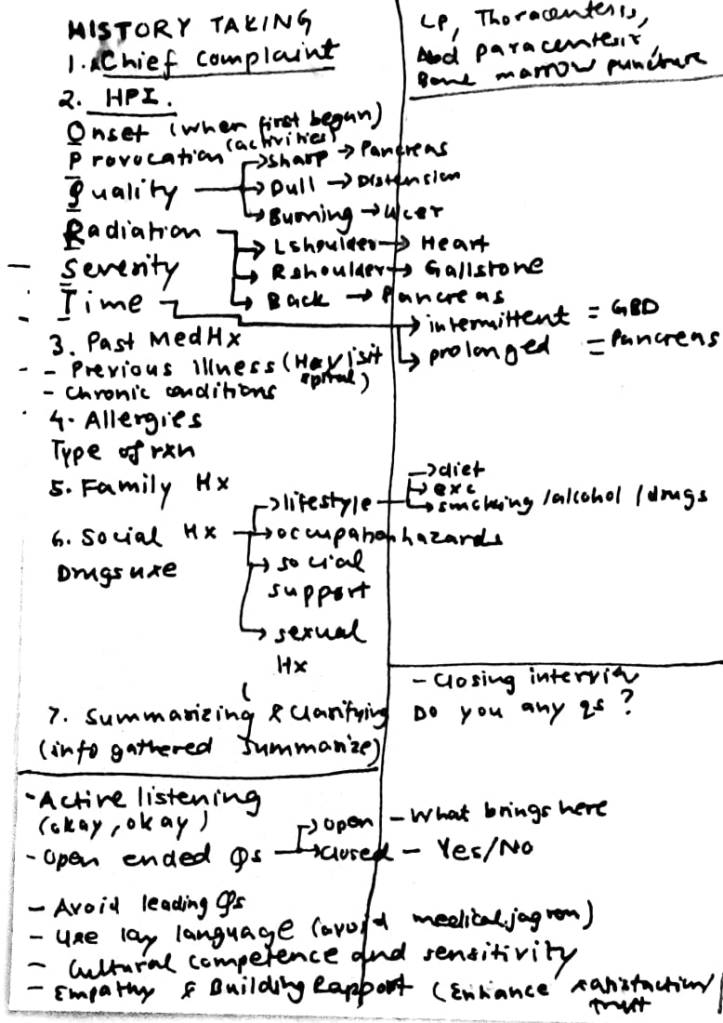
Medical History collection
Case-based medical history collection; this was subjective.
Here is a quick preview of my notes on how to take patient history during lectures in university; as advice, they’re quick notes, not in-depth material, but are handy when it comes to on-site work.
Auxilary Examination
Cardiopulmonary auscultation, electrocardiogram, imaging etc.
Internal medicine or Surgery (Patient consultation and techniques)
AI based patient consultation. We could talk to the AI patient and diagnose them based on the symptoms they presented with; it was one of the most interactive and valuable experiences.
The university provided us with an app where thousands of AI patients with different conditions are available, allowing us to practice and learn for the real exam. We could talk to them using a microphone, and they answered clearly using their voice like a real-world patient.
The app evaluates us based on our professionalism and steps followed while concluding the patient’s diagnosis.
During Exam — The practice sessions proved invaluable; on the day of the OSCE my patient turned out to be a Mexican female presenting with appendicitis.
Conclusion
Exam day was crucial and honestly I felt like a complete doctor once it was done, not because I was confident about the score, but the learning and preparation to qualify for this exam challenged us to become better students and metamorphose into doctors from interns.
We as students are forever grateful to China Medical University for providing us all the resources necessary to shape us into brilliant physicians and, most importantly, to our teachers who always go the extra mile to teach us every skill.
A big thank you to my best friend Jaseena for being a part of this transformative journey of six years, from students to doctors.
Sharing an amazing book I came across for OSCE skills, which has the exact checklist you need while performing a physical exam. I found it on the night of the exam, so we didn’t use it at that time, but it would be helpful for the future in the clinic and for the readers who are yet to give OSCE.


Leave a comment